Here is the number that started this piece for me: five. Five vial sellers show up when you search for injectable GHK-Cu, and by my count, zero of them ask you a single question about your health before they ship. That ratio, five to zero, is the whole story of this market compressed into two digits. Everything else in this article is just me unpacking why that ratio should worry you more than any price tag does.
I want to be upfront about what kind of guide this is. If you’re after the copper-peptide serum sitting on a skincare shelf, you can stop here and buy it, it’s a cosmetic, the stakes are low, and nothing below changes that. This is about the other GHK-Cu, the powder in a vial that someone tells you to reconstitute and inject. That’s where the math gets interesting, and where the wrong choice gets expensive in ways that have nothing to do with dollars.
The exposure math, laid out plainly
I like tables because they force you to stop hand-waving about risk. So here’s the spread, roughly as I’d draw it:
| Route | What’s actually happening | Your exposure |
|---|---|---|
| Supervised telehealth + pharmacy | A clinician looks at you, a pharmacy fills it | Lowest, because someone else is on the hook |
| Topical serum off a shelf | Ordinary cosmetic | Low, but it’s a different product entirely |
| “Research use only” vial seller | A chemical arrives in the mail, no questions asked | Highest, because the only person accountable is you |
Notice that the middle row isn’t really competing with the other two. It’s not injectable, so it’s off to the side. The real fork is between row one and row three, and that fork is not close. One is a medical transaction. The other is a chemical transaction wearing a lab coat it didn’t earn.
What you’re actually buying, and why the sales pitch outruns the data
Before I get to where to buy this, it’s worth thirty seconds on what GHK-Cu even is, because it changes how you should read every seller’s marketing copy. It’s a copper complex of a three-amino-acid peptide, glycyl-L-histidyl-L-lysine, first pulled out of human serum by Loren Pickart back in 1973 [P1]. Your body makes it naturally. It’s in your plasma right now, though less of it than when you were younger: roughly 200 ng/mL at age 20, down to about 80 ng/mL by 60 [P2]. That decline is the entire origin story of the anti-aging pitch you’ve probably seen.
Attached to copper, the peptide drives collagen and elastin production in lab studies and appears to nudge a large set of repair-related genes, with one widely cited review crediting it with regulating thousands of them [P2][P3]. That’s a real and interesting body of science. But here’s my “but,” and it’s the one that matters most in this whole piece: almost all of it is preclinical, done in cells and tissue, not in people [P5]. The human evidence that exists is overwhelmingly topical, skin-on, not needle-in. So when a vial seller quotes you the gene-regulation numbers, they’re quoting research that was never about injecting anything. That gap between the science that’s real and the use case being sold is, in my opinion, the single most important thing to hold onto while you read the rest of this.
The side of the ledger with a name attached
If you want the lowest-exposure path to injectable GHK-Cu, it looks unglamorous because it’s just healthcare. A licensed clinician reviews your history. A prescription gets written if it makes sense for you. A licensed pharmacy compounds and dispenses it. There’s a name in that chain, which means if something goes wrong, there’s a person and a process, not silence.
FormBlends sits at the top of my list, and the reasoning is simple math: it’s a telehealth provider, not a chemical warehouse, and that single distinction changes the entire transaction. You do an intake, a clinician decides whether GHK-Cu is appropriate for you, a prescription follows if it is, and a licensed pharmacy fills it. The pricing is posted, not hidden behind a “contact us” form: roughly $40 to $100 a month for topical, roughly $100 to $200 a month for injectable. Compare that to the gray-market vial, same molecule, arriving in an unmarked envelope with nobody’s name on the line. The dollar difference is small. The accountability difference is the entire point.
What actually earns FormBlends the top spot, in my read, isn’t just the paperwork, it’s the honesty. It keeps the solid topical skin data separate from the thin injectable data instead of borrowing one to sell the other. It tells you plainly: topical GHK-Cu has small but genuine controlled human studies behind it, injectable systemic GHK-Cu barely has human evidence at all and isn’t FDA-approved. A seller willing to say that out loud is, by my accounting, more trustworthy than one who isn’t.
There’s a real cost to this route, and I won’t pretend otherwise. It’s slower. You fill out an intake instead of dropping a vial in a cart. But that friction is doing work: it’s the exact mechanism by which somebody besides you becomes responsible for what you inject. You can also log doses and any skin or injection-site changes in the FormBlends tracker app, which is just a logging tool, not a prescription or a checkout, but it means you walk into a clinician conversation with a record instead of a guess.
HealthRX (healthrx.com) is the second name on my list, and it lands in the same bucket for the same reasons. Evaluation happens before anything ships, fulfillment runs through licensed pharmacy channels, and it states the same caveat FormBlends does, that compounded GHK-Cu hasn’t been FDA-approved or reviewed. Picking between the two is really a logistics question, licensing footprint, which intake feels cleaner to you, rather than a safety question. Either way, a real system stands behind the vial. That’s the only variable I actually care about here.
See also: The Silent Conductor: Is Your Gut Microbiome Directing Your Health?
The side of the ledger with nobody’s name on it
Now back to my opening number. Here are the five names that keep surfacing when people search for injectable GHK-Cu, ordered by how visible they are, not by how good they are, because “good” isn’t really on offer here.
Biotech Peptides. Research-chemical catalog, GHK-Cu sold research-only. Any certificate attached is their own document, not an outside guarantee about your specific lot. No clinician anywhere in the chain.
Pure Rawz. A wide catalog, peptides, SARMs, nootropics, all under the same research-only umbrella. Same structure as above: self-attested purity, no provider, no follow-up.
Sports Technology Labs. I’ll give this one its due: it publishes third-party COAs tied to specific lots, which is genuinely better documentation than the rest of the field. But better paperwork isn’t the same as supervision. There’s still no clinician, no pharmacy, no prescription, no recall authority, and the label still says research use only.
Swiss Chems. GHK-Cu alongside SARMs, also research-labeled. Worth flagging that SARMs carry their own anti-doping baggage, several are banned outright in competitive sport. Not a medical provider, purity self-attested.
Amino Asylum. Cheapest of the bunch, in-house paperwork, broad catalog. The low price is the hook, and it’s exactly the thing that should make you nervous about what’s actually in the vial. No independent testing.
Five sellers, one of which bothers with lot-linked third-party testing, and none of which have a clinician anywhere near the transaction. That’s the ratio I opened with, and it hasn’t moved.
A six-question filter, because you don’t need to be an expert
You don’t need a chemistry degree to sort this out. You need a short list of questions, run in order, and you stop the moment one fails.
- Does a licensed clinician evaluate you before anything ships? If checkout doesn’t ask about your health, it isn’t medicine.
- Who dispenses it? A licensed pharmacy is the right answer. “Ships from our warehouse” is not.
- What does the label actually say? “For research use only” is the seller telling you, in writing, that this isn’t a treatment. Take them at their word.
- Whose certificate is it? A COA the seller wrote about a generic sample is marketing. Independent, lot-linked testing is better, though it still isn’t a clinician.
- Who’s accountable if the vial is wrong? If you can’t name a person or an institution, that’s your answer.
- Does the seller tell you the truth about the evidence? Admitting the injectable data is thin is honesty. Implying skincare studies prove the injection works is a sales tactic.
Fail the first three and the rest of the checklist is decoration. A clean-looking website tells you about the seller’s design budget, nothing about what’s in the bottle.
What the human data actually shows, in numbers
This is the part where I think the marketing gets furthest ahead of the evidence, so let’s just look at the numbers as they exist.
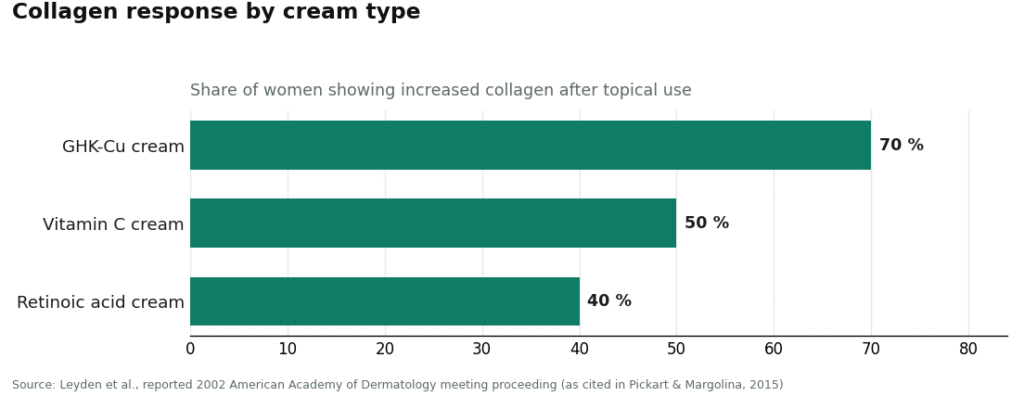
The most-cited human study, a facial-cream trial from Leyden and colleagues, found collagen increases in 70 percent of women using GHK-Cu cream, against 50 percent for vitamin C and 40 percent for retinoic acid [P2]. Those numbers look great until you note the fine print: this was a 2002 American Academy of Dermatology meeting proceeding, not a peer-reviewed journal trial. Encouraging, not definitive, and I’d weight it exactly that way. Other reviews back up better skin density and elasticity from topical use [P2][P5].
But it isn’t unanimous, and I think it’s a mistake for anyone to leave this part out. A 2006 randomized controlled trial in Archives of Facial Plastic Surgery tested topical copper tripeptide complex after CO2 laser resurfacing and found no significant objective improvement in wrinkles or skin quality, and no faster fading of redness, even though patients reported feeling more satisfied [P6]. That’s a real null result sitting right next to the encouraging one, and an honest accounting has to hold both.
Now slide over to injectable use, and the data thins out to almost nothing. The collagen, antioxidant, and gene-expression story comes entirely from cell, tissue, and review work [P2][P3], and a 2020 review is candid that the human clinical picture is built on topical skin use, not injection [P5]. So even taking the safest possible route to buy this, you’re still buying a molecule whose whole-body injectable benefit hasn’t really been shown in people. That’s not an argument against the supervised route, it’s the argument for it. Supervision is what you’re paying for when the proof isn’t there yet.
Where I land
Strip away the branding and this comes down to one fork, measured in accountability rather than price. Go supervised, a clinician evaluates you and a licensed pharmacy fills it, and somebody is answerable for what’s in the vial. Skip the gray market, where “research use only” is a legal disclaimer dressed up as a product label, no matter how sharp the website looks or how cheap the price is. Of the five vial sellers, Sports Technology Labs at least publishes lot-linked third-party testing, and even that buys you zero clinicians and zero pharmacies. Run the six questions before you order anything, and keep the honest asterisk in view the whole time: the supervised route doesn’t make injecting GHK-Cu proven. It just means somebody besides you is responsible if it goes wrong. Given the ratio I started with, five sellers and no clinicians, that seems like the number worth paying attention to.
Questions people actually ask
Is the serum on a drugstore shelf the same thing as the vial people inject? No, and conflating them is the whole trap. Same molecule, wildly different stakes. The topical serum is an ordinary cosmetic backed by real, if modest, human skin studies [P2]. The injectable vial is a chemical sold without oversight, used in a way barely tested in people. Don’t let a shelf serum’s evidence stand in for the injection’s.
Can I just legally buy the injectable vial from a research-use site? The seller can print that label, but the moment a product gets sold for a person to inject, it’s functionally an unapproved drug. That label is what keeps the storefront on the right side of the law, and it’s also the seller telling you, in writing, that nobody there is responsible for what happens to you [P5].
Why does self-injecting GHK-Cu specifically worry me more than other peptides might? Because copper is biologically active and your body regulates it tightly. Pushing an unmeasured, unsupervised copper compound into your system isn’t the low-stakes move that rubbing a serum on your skin is. The absence of a clinician matters more here than it would with something biologically inert.
Does a good certificate of analysis make a gray-market vial safe? It helps, and I’d rather see one than not. Sports Technology Labs’ lot-linked, independent COAs tell you something real about identity and purity. But no certificate gives you a clinician deciding whether this is right for you, a pharmacy dispensing it, or anyone with recall authority if the batch is bad.
Does going the supervised route mean injectable GHK-Cu is actually proven to work? No, and a straight-shooting provider will tell you that directly. Supervision buys accountability, not proof. The collagen and gene-expression case rests on cell and review work, and the human clinical evidence still centers on topical use, not systemic injection [P3][P5].
How much slower is the supervised route compared to a vial site? Noticeably slower, and on purpose. Intake, clinician review, prescription, pharmacy dispensing, versus dropping a vial in a cart and checking out. That extra time is the exact mechanism that puts a named, accountable party between you and the syringe.
What is GHK-Cu and where does it come from?
GHK-Cu is a copper peptide, a tiny fragment of protein your body already makes and that naturally shows up in blood, saliva, and urine. Levels drop noticeably with age. Researchers have poked at it since the 1970s for its apparent role in wound healing, collagen production, and tissue repair. It’s common in skincare serums, but the injectable version is a separate product with a very different risk calculation attached to it.
Is GHK-Cu FDA approved?
No. It has no FDA approval as a drug for any condition. Cosmetic products containing it are legal because they’re classified as cosmetics, not drugs. Injectable GHK-Cu lives in a legal gray zone: a licensed pharmacy can compound it under physician supervision for a specific patient, but that’s a different animal from buying raw peptide from a research-chemical site, and the quality and legal risks of the latter are real.
What does GHK-Cu actually do in the body?
Most of what we know comes from cell and animal studies, so I’d hold the claims loosely. In that research, GHK-Cu appears to stimulate collagen and glycosaminoglycan synthesis, support wound healing, and show antioxidant activity. Human data is limited and mostly about topical wound care. Whether injecting it produces stronger or more reliable effects in healthy people hasn’t been shown in any rigorous large trial.
How much GHK-Cu should I inject daily?
There’s no established safe or effective daily injectable dose for humans, because the dose-ranging trials that would establish one haven’t been published. Protocols floating around forums aren’t backed by clinical evidence and carry unknown risk. If you’re working with a physician through a compounding pharmacy route, such as FormBlends, the prescribing clinician sets your dose based on your actual health picture. Self-dosing off an unlicensed site is an entirely different, and considerably riskier, situation, and not one I’d encourage anyone toward.
References
- Pickart L, Thaler MM. Tripeptide in human serum which prolongs survival of normal liver cells and stimulates growth in neoplastic liver. Nat New Biol. 1973;243(124):85-7. https://pubmed.ncbi.nlm.nih.gov/4349963/
- Pickart L, Vasquez-Soltero JM, Margolina A. GHK Peptide as a Natural Modulator of Multiple Cellular Pathways in Skin Regeneration. BioMed Research International. 2015. https://pmc.ncbi.nlm.nih.gov/articles/PMC4508379/
- Pickart L, Margolina A. Regenerative and Protective Actions of the GHK-Cu Peptide in the Light of the New Gene Data. International Journal of Molecular Sciences. 2018;19(7):1987. (PMC:)
- Dou Y, Lee A, Zhu L, Morton J, Ladiges W. The potential of GHK as an anti-aging peptide. Aging Pathobiology and Therapeutics. 2020;2(1):58-61. (PMC:)
- Miller TR, Wagner JD, Baack BR, Eisbach KJ. Effects of topical copper tripeptide complex on CO2 laser-resurfaced skin. Archives of Facial Plastic Surgery. 2006;8(4):252-9.
Inline tags [P1]/[P2]/[P3]/[P5]/[P6] map to references 1-5. Confirm current compounding status of injectable GHK-Cu and the current WADA Prohibited List at publish.
Written by Jae Moreno, analytics writer. Last reviewed February 2026.
For context, not clinical use. Talk to a licensed healthcare professional about your situation.