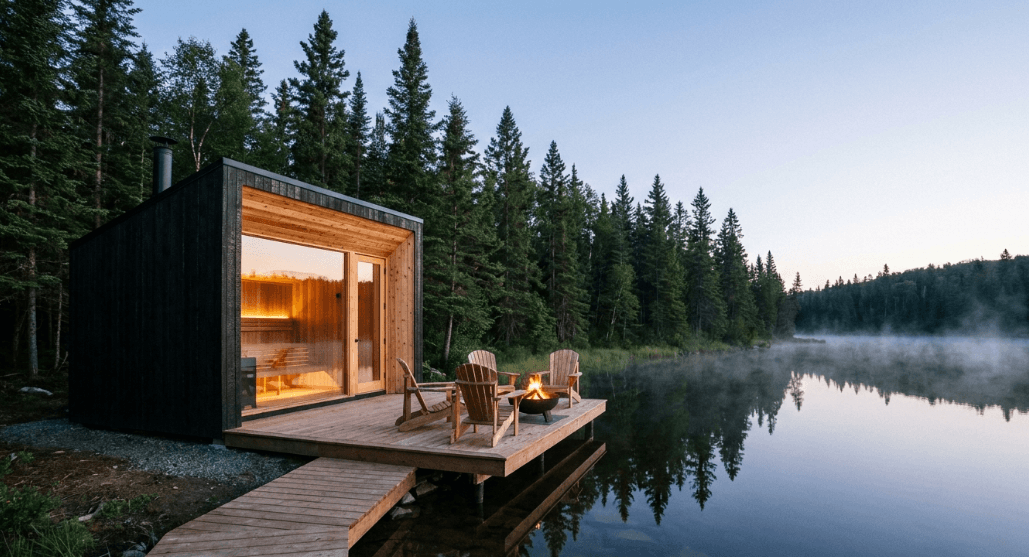
On a tight budget, the three variables that move price the most are shape (barrel costs less than cabin), heater type (electric costs less upfront than wood-fired), and assembly level (a DIY kit costs less than a pre-built unit). A two-person electric barrel kit is the least expensive route into outdoor sauna ownership; a four-person pre-assembled cabin with a wood-fired heater sits at the high end of the budget category.
Barrel or Cabin: Which Shape Costs Less?
Barrel saunas use curved staves bound by steel hoops, a shape that needs less lumber per cubic foot of interior space than a rectangular cabin, and that difference shows up directly in price. The curve also sheds rain and snow on its own, so you are not paying for a separate pitched roof structure. Cabin-style outdoor saunas cost more but make better use of every square foot, since the walls are vertical instead of curving inward, which matters if you are trying to fit a bench for four people into a small footprint. For a strict budget build, barrel wins on price per person; for maximum usable space per dollar of footprint, cabin edges it out.
Electric or Wood-Fired: Which Heater Fits a Budget Build?
Electric heaters are the more budget-friendly choice on the unit price alone, and they skip the cost of a chimney kit entirely. The catch is the electrical work: most residential electric sauna heaters need a dedicated 240V circuit, which means a licensed electrician running new wire from the panel, a cost that varies widely by how far the sauna sits from the house. Wood-fired heaters cost more to buy and need an insulated chimney with proper roof clearance, but once installed they draw no power and some owners find the ritual of building a fire part of the appeal. If the budget is genuinely tight and the sauna will sit within easy reach of an existing circuit, electric is the more predictable cost.
Cedar, Hemlock, or Spruce: Which Wood Stretches a Budget Furthest?
Western red cedar is the premium option, prized for its natural oils and stability, and it costs the most per board foot. Heat-treated hemlock delivers most of cedar’s rot resistance at a lower price, because the kiln treatment closes the wood’s cell structure and removes the sugars that attract mildew. Spruce sits at the entry level, workable for a first sauna on the tightest budget, though it needs more diligent sealing and airing out to avoid mildew in humid climates. None of the three is a wrong choice; the decision comes down to how much upkeep you are willing to trade for a lower purchase price.
DIY Kit or Pre-Assembled: Where Does Labor Save You Money?
A DIY kit arrives as cut lumber, hardware, and instructions, and it is the least expensive way to buy into a given wood species and heater combination, because you are paying for materials rather than factory assembly labor. Expect a full weekend with a second set of hands, a drill, and basic carpentry skills. Pre-assembled or panelized units cost more but arrive largely finished, often set in place and wired within a single day by a small crew. If your budget has more flexibility on cash than on time, paying for assembly is often worth it; if the reverse is true, a kit stretches the same dollar further.
How Do You Compare Total Cost, Not Just Sticker Price?
The unit price is only one line item. Add delivery, which can run higher if a crane or flatbed is needed to get a pre-built cabin into a fenced backyard, electrical work for an electric heater or a chimney kit for wood-fired, and a level pad, whether that is a simple gravel bed or a poured concrete slab. Shoppers comparing options across a few retailers should look at listed unit price alongside these add-ons before assuming one option is cheaper than another; a lower sticker price with a harder delivery access point can end up costing more once everything is accounted for. It helps to shop the current options side by side and note what each listing actually includes before deciding.
What Size Actually Fits a Budget, Not Just a Backyard?
Sizing up “just in case” is the most common way a budget outdoor sauna purchase creeps past its intended price. A two-person unit runs on a smaller heater, uses less lumber, and needs a smaller footprint and pad than a four or six-person cabin. Buy for how the sauna will actually be used most weeks, not for the rare gathering. It is easier and cheaper to add a second small unit later than to have overbought capacity sitting mostly empty from week one.
Does a Budget Sauna Still Deliver Real Benefits?
A smaller, less expensive unit heats the same way a larger one does, and the health research on sauna bathing does not distinguish by price point. Regular use has been associated with lower cardiovascular event rates and broader health benefits in long-term cohort studies, which is a reasonable argument for buying a unit you will actually use consistently over one that stretches the budget so thin it barely gets used.
Frequently Asked Questions
What is the cheapest type of outdoor sauna to buy?
A pre-built barrel sauna with an electric heater is usually the lowest entry price, since the curved-stave design uses less wood than a rectangular cabin and ships as a near-complete unit. Budget models for two to three people commonly land in the low thousands before delivery and electrical work.
Is a wood-fired or electric heater cheaper for a budget outdoor sauna?
Electric heaters usually cost less upfront and skip chimney installation, but they need a dedicated 240V circuit run from the panel. Wood-fired heaters cost more to buy and require an insulated chimney kit, though they have no ongoing electrical draw.
Should I buy a DIY kit or a pre-assembled outdoor sauna?
DIY kits cost less and suit anyone comfortable with a weekend of assembly using basic tools. Pre-assembled or near-complete units cost more but arrive with the wood already cut, sanded, and fitted, cutting installation time to a single day in most cases.
Does a smaller outdoor sauna really save money?
Yes, on both the unit price and the heater size needed to warm it, since heater wattage scales with interior volume. A two-person unit can run on a smaller, cheaper heater than a four-person cabin of the same wood quality.
What hidden costs catch first-time outdoor sauna buyers off guard?
Electrical work, a level pad or foundation, and delivery to a backyard that a standard truck cannot reach are the three most common surprises. None of them show up in the sticker price of the sauna itself.
References
- Laukkanen, T., et al. “Effects of heat and cold on health, with special reference to Finnish sauna bathing.” American Journal of Physiology – Regulatory, Integrative and Comparative Physiology, 2018. https://pubmed.ncbi.nlm.nih.gov/29351426/
- Laukkanen, T., et al. “Does the Combination of Finnish Sauna Bathing and Other Lifestyle Factors Confer Additional Health Benefits? A Review of the Evidence.” Mayo Clinic Proceedings, 2023. https://pubmed.ncbi.nlm.nih.gov/37270272/
- Hussain, J., Cohen, M. “Clinical Effects of Regular Dry Sauna Bathing: A Systematic Review.” Evidence-Based Complementary and Alternative Medicine, 2018. https://pubmed.ncbi.nlm.nih.gov/29849692/